Hello,
Hi! I'm Isaac.


I am an 12th grade student at Middle College High School.


I am an aspiring applied physicist and electrical engineer with a passion for development and research physics.

My projects specialize in quantum analyses of probability, entropy, and special relativity. I hope to gain traction in latter postgraduate research to contirbute to the application of these sciences in microscopic instances such as biomedical nanotechnology and advanced circuitry.


I also love mountaing hiking, surfing, and language learning. Σταμάτα να χρησιμοποιείς το μεταφράζω και μάθε το Κυριλλικό αλφάβητο και τα Ελληνικά.

Accretion Disk Simulation Screenshot

2.1 Proof of Refined Quantum Hill Theory in Proposed Radial Eigenstates

A nanoanalogue model of Kerr-Newman black holes was created to quantify energy states in quantum sciences around certain systems. Similarly to previous black hole simulations, such as the Blandford-Znajek jet program, the simulation ran expected according to classical dynamics. However, in light of recent research in quantum wells, theories on material accumulation around a black hole due to spin rates was theorized.

Furthermore, I have hypothesized that the accumulation of mass around a spinning black hole is comparable to the material accumulation within quantum wells. The mass rate spin of crystalline and gaseous substances around a black hole creates a similar resonance to that of a quantum well, more importantly. The criticality of this study lies in further implications that super-radiant physics holds for nuclear and applied elementary particle physics.

Read →
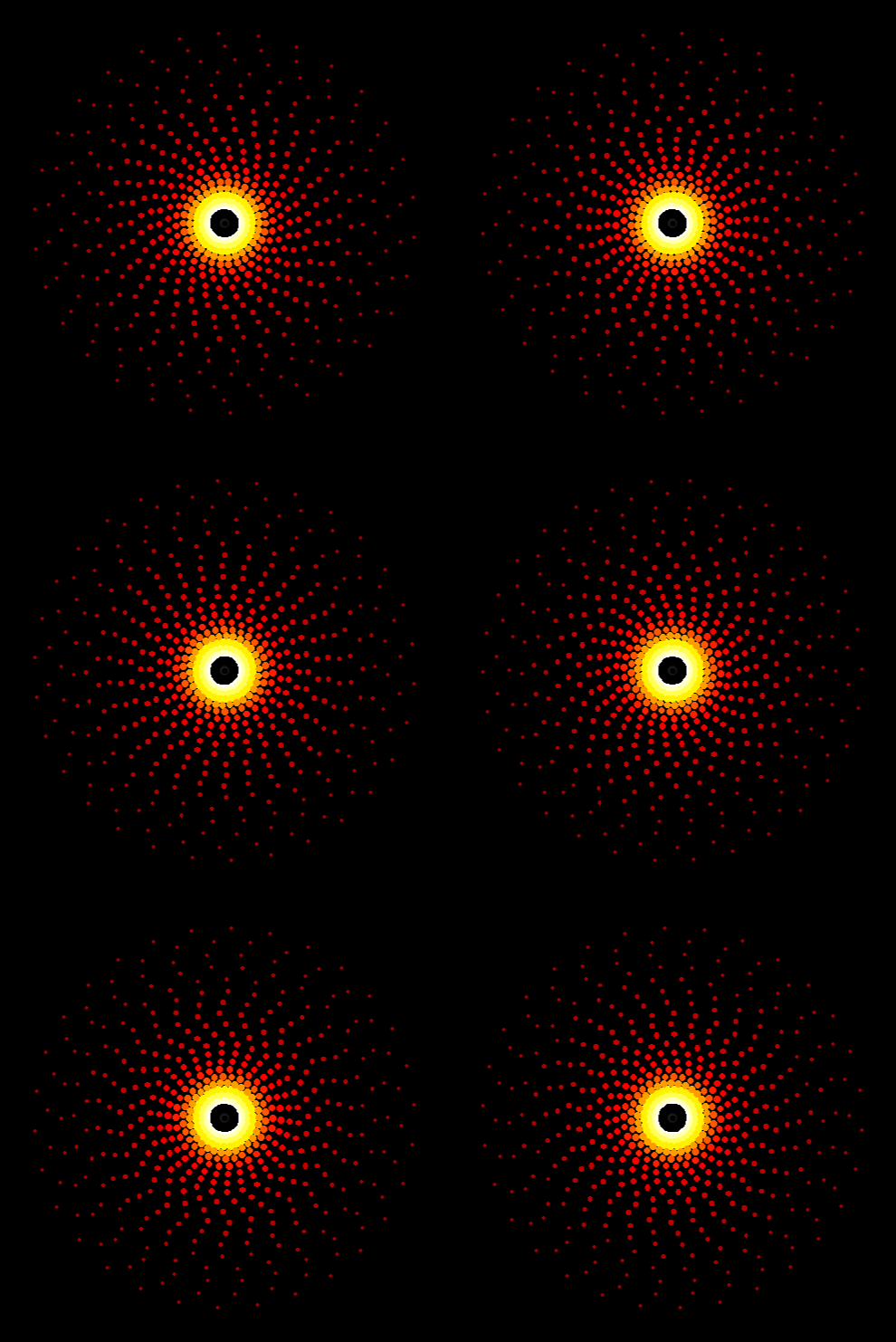
Accretion Disk Simulation

1.1 A Localized Effective Potential Anomaly in Quantum States Near the Kerr ISCO Evidence for a Metastable Radial ConfinementRegion (1)

This simulation models swirling matter spiraling into a black hole. I built this using Python and matplotlib to visualize disk density and relativistic frame dragging effects.

Synopsis →
Accretion Disk Simulation Screenshot

1.2 Accretion Disk Program Paper

This paper summarizes the processing and findings of the accretion disk simulation project. It discusses the physical principles behind accretion disks and the computational methods used to model them.

Read →

1.3 Dark Matter and Keplers Third Law of Planetary Motion

The deduction of the existence of dark matter can be partially attributed to inferences made using Kepler's third law. One can deduce, from this law, that there is a positive relationship between the increase of mass and increase in velocity, exponentially and vice versa for a decrease in mass. In modern day physics, the scientific community has recognized a common pattern in the formation and structure of a stellar system to be that lighter, less massive, more gas based bodies orbit towards read more. the rims of systems. Therefore, using Kepler's third law, we can deduce that the velocity of objects, in general, decrease due to a decrease in mass. However, data from telescopes and other observational mediums have shown that velociities of objects around the rims of systems are very close to the speed of ones closer to the rim. When viewing graphs, users can also see that the calculation based system shows a negative exponential behavior, whereas the reality concludes a flat, slightly decreasing, line. Therefore, we can deduce the existence of furhter, non-luminous, mass, also known as dark matter.minimize

Learn More →